


In 2025-26 our carbon footprint was 180 tonnes CO2e, which is an increase of 10 tonnes CO2e (6%) from the revised 2024-25 figure (170 tonnes CO2e).
This equates to 0.91 tonnes CO2e per Full-Time Equivalent employee, which is a 10% increase from the 2024-25 figure of 0.83 tonnes CO2e.
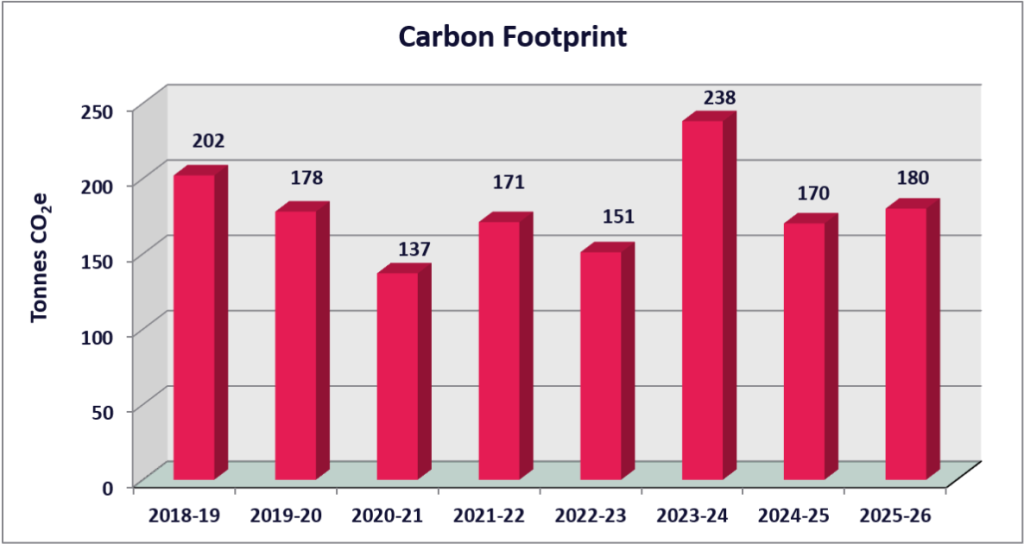
Our carbon footprint is calculated based on the current UK Government guidance and conversion factors for greenhouse gas reporting issued by Department for Energy Security and Net Zero.
Our approach has been externally validated by Carbon Footprint Ltd. in relation to the ISO 14064-3: 2019 standard. The verification activities have shown that Changeworks has met the verification criteria satisfactorily.
Our calculation includes the following emissions:
- Scope 1 – Direct emissions from the activities that are under our direct control, such as fuel combustion and vehicle emissions.
- Scope 2 – Indirect emissions related to the production of electricity and heat that is purchased.
- Scope 3 – Other indirect emissions resulting from activities that are neither owned nor controlled, including emissions related to business travel, electricity transportation and distribution, well-to-tank, waste treatment, employee commuting, home working and some of our purchased goods and services.
Since 2018-19, our carbon reduction and offsetting activities have enabled us to be recognised as a Carbon Neutral Organisation.
The slight increase in our carbon footprint is due to:
- Electricity use being slightly up due to the inclusion of energy data from our small office space in Shetland. This missing data had been pointed out in previous verification reports, and we’ve been trying to obtain it for a few years now to make our footprint more accurate.
- An increase in most of the different modes of travel as Changeworks’ geographical footprint is growing. There were some more flights and train travel across the UK to serve both existing and new areas that we’re now covering and there was also an international flight to support the Scottish Government’s inward investment into climate mitigation. These all-drive impact but also come at a carbon cost.
- The profile of where staff are based has also evolved, which has contributed to the impact on emissions from staff using their own cars, more hybrid car usage, and heating systems colleagues use in their homes whilst homeworking.
- The choice that’s been made to recruit more staff within in their own communities, particularly in the Highland and Islands, meaning that they often aren’t in close proximity to EV / hybrid pool cars and have limited access to public or low carbon transport.
As one of Scotland’s leading environmental organisations, we are committed to reducing our footprint as we go about helping others to reduce theirs. To achieve this, we have a Carbon Reduction Strategy and Plan, an Environmental Policy, a Travel Hierarchy, a Sustainable Procurement Policy and Guidelines and a Sustainable Events Checklist.
In 2020-21, a new approach to the Changeworks Carbon Reduction Plan introduced targets aimed at reducing our carbon footprint to 70% of our 2018-19 calculation by 2030. This equates to a challenging 14% year-on-year reduction, with a view to becoming true net zero by 2040, reflecting the Scottish Government’s ambition at that time.
We aim to achieve delivery of this through our Carbon Reduction Strategy and Plan. This details our:
- Ongoing initiatives with the Carbon Reduction Team
- Continuing engagement with our suppliers
- Comprehensive range of environmental policies and guidance which are reviewed and communicated each year.

Carbon Database Initiative
The Carbon Database Initiative is a global database that enables organisations to disclose their carbon footprint, net zero commitments and carbon neutral claims. Changeworks is proud to join this growing network of businesses and organisations.
Useful pages
Is this page useful?